
HUMANOID ROBOT MANUFACTURER
Booster Robotics in Canada
Developer-focused humanoid robots built for embodied AI, research, education and real-world experimentation.
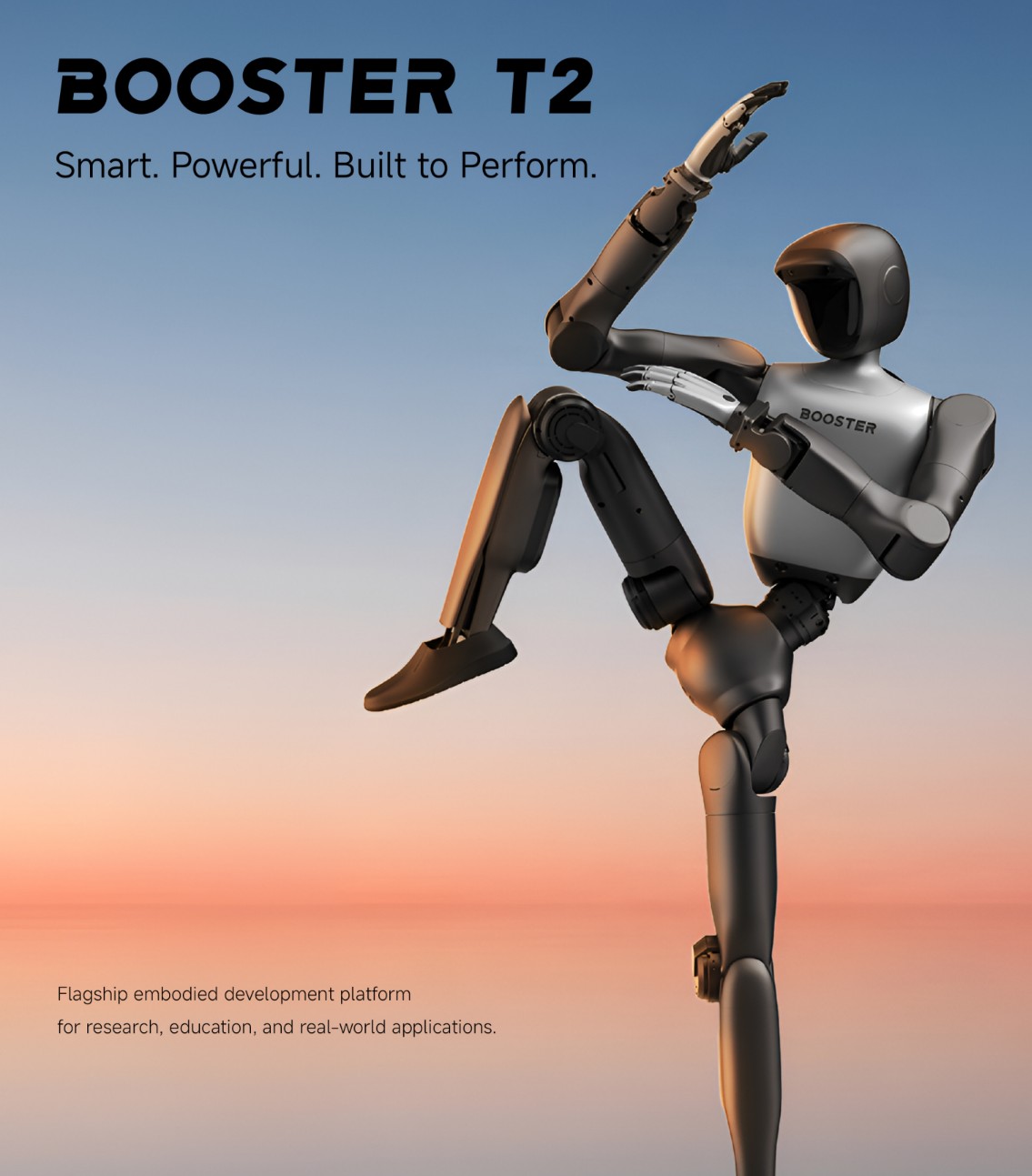
Booster Robotics is a rapidly growing humanoid robotics company developing accessible platforms for researchers, universities, developers and organizations exploring embodied artificial intelligence. Its current lineup ranges from the compact Booster K1 to the developer-focused T1 and the more advanced Booster T2.
HumanoidX provides Canadian organizations with local guidance, integration planning and deployment support for humanoid robotics projects.
Founded
2023
Headquarters
Beijing, China
Initial focus
Research and education
Platforms
K1 · T1 · T2
Dev Ecosystem
SDK · ROS 2 · Gym · Deploy
Last reviewed by HumanoidX: July 2026
A New Humanoid Robotics Company Built on Decades of Experience
Booster Robotics was established in 2023 with the goal of accelerating the development and adoption of humanoid robots. Although the company itself is relatively young, its founding team brings significant experience in robotics, software, semiconductors and commercialization.
Founder and CEO Cheng Hao earned his bachelor's and master's degrees from Tsinghua University, while core members of the company came from the Tsinghua Robot Control Laboratory and the university's Hephaestus RoboCup team. According to Booster Robotics, the team draws on approximately two decades of accumulated experience in humanoid robotics.
The company's early strategy has centred on research and education. Rather than initially attempting to build a fully autonomous general-purpose worker, Booster has concentrated on creating capable, durable and developer-accessible humanoid platforms that universities, laboratories, competition teams and embodied-AI developers can program and improve.
"Booster Robotics is not simply building robots. It is building a development ecosystem intended to help researchers and developers move embodied-AI ideas from simulation into physical machines."
HUMANOIDX PERSPECTIVE
Why Booster Robotics Has Attracted Global Attention
Developer accessibility
Booster platforms are designed to support secondary development, allowing research teams to build their own perception, locomotion and decision-making systems.
Durable hardware
The T1 and K1 have been positioned for demanding development and competition environments where falls and repeated testing are expected.
Competition validation
Booster robots have been used by international university teams in RoboCup and humanoid robotics competitions, earning multiple podium finishes.
Open development resources
Booster provides SDKs, ROS 2 support and open-source resources for reinforcement learning, simulation and real-world deployment.
Broad product range
The lineup covers compact introductory robots, research-grade developer platforms and a larger flagship intended for advanced manipulation and embodied-AI projects.
The History of Booster Robotics
Booster Robotics is founded
Booster Robotics Technology Co., Ltd. was established. The company was founded by Cheng Hao, a Tsinghua University graduate, with a core team connected to Tsinghua's robotics research and RoboCup programs.
BR002 is unveiled
Booster presented its BR002 humanoid robot technology, demonstrating dynamic movements that included turning and standing up.
Booster T1 debuts
The Booster T1 appeared at the 2024 World Robot Conference and attracted attention through demonstrations including kicking, push-ups and martial-arts-inspired movements.
Pre-Series A financing
Booster Robotics announced a Pre-Series A financing round intended to support general-purpose humanoid hardware and software-development capabilities.
IEEE-RAS Humanoids victories
At IEEE-RAS Humanoids 2024 in Nancy, France, the Booster T1 placed first in both a speed competition and an obstacle-avoidance and door-opening challenge.
Official RoboCup partnership
The RoboCup Federation announced Booster Robotics as an official partner, supporting research, education and participation in robot-soccer competitions.
International competition growth
Throughout 2025, Booster robots were used by university and research teams in international RoboCup and humanoid robotics events. The T1 supported AdultSize teams while the K1 was adopted for KidSize competition and education.
Series A and Series A+ financing
Booster announced Series A and Series A+ financing rounds to support product development, manufacturing and global delivery.
Booster Ecosystem Summit
Booster held its first Ecosystem Summit and introduced initiatives including the Booster K1, the Booster Agents system, developer-support programs and an education-market initiative.
Major financing and endurance demonstration
Booster announced a financing round of nearly US$150 million. The company also publicized a humanoid half-marathon performance completed in one hour and 53 minutes as a demonstration of locomotion stability and endurance.
RoboCup 2026 results
Booster reported that its robots earned three gold, two silver and three bronze medals at RoboCup 2026. The company stated that 38 of the event's 59 teams competed using Booster robot platforms.
Company-history milestones are based on Booster Robotics' official history and news publications. Competition results and financing information are presented as company-reported information.
Booster Robotics Humanoid Robot Lineup
Booster Robotics currently offers three principal humanoid platforms. Each targets a different level of development, physical capability and project complexity.
Which Booster Robot Is Right for Your Project?
The right platform depends on much more than height or price. Buyers should consider the robot's intended task, required compute, manipulation needs, operating environment, battery requirements, safety plan and the amount of custom development necessary.
More Than Hardware: The Booster Developer Ecosystem
A humanoid robot becomes useful through the software, simulation tools, models and development workflows built around it. Booster Robotics provides a growing ecosystem intended to help development teams move from training and simulation to deployment on physical robots.
Booster SDK
An integration toolkit supporting secondary development on Booster robot platforms.
ROS 2 SDK
Tools intended to help robotics developers connect Booster platforms with ROS 2 workflows.
Booster Gym
An open-source reinforcement-learning framework for training locomotion and robot-control models.
Booster Train
An Isaac Lab-based framework for reinforcement-learning tasks and simulation experiments.
Booster Deploy
A lightweight deployment framework supporting simulation-to-simulation and simulation-to-real workflows.
Booster Assets
Robot models, datasets and development resources for Booster platforms.
Booster App
A mobile application for robot control, status feedback and network configuration.
RoboCup Demo Resources
Development resources covering perception, localization, decision-making and execution for robot-soccer applications.
What Can Booster Robots Be Used For?
Embodied-AI research
Researchers can explore how AI systems perceive physical environments, make decisions and control a mobile humanoid body.
Locomotion and reinforcement learning
Booster robots support research into walking, balance, recovery, dynamic movement and simulation-to-real transfer.
Robot soccer and competition
The T1 and K1 have become visible platforms for university robot-soccer teams and international robotics competitions.
University laboratories
Booster robots can provide a physical development platform for robotics, computer science, engineering, AI and human-robot interaction programs.
Robotics education
The K1 offers a relatively compact platform for courses, student projects and introductory embodied-AI programs.
Human-robot interaction
Researchers can study speech, gestures, social behaviour, user trust and interaction between people and humanoid machines.
Events and demonstrations
Humanoid robots can create memorable demonstrations, educational exhibits and technology showcases when operated within an appropriate safety plan.
Commercial pilot projects
The T2 may be evaluated for visitor engagement, guided interaction, research demonstrations and other controlled commercial pilots.
Real-world deployments normally require:
Evaluating Booster Robotics for a Canadian Project
Canadian organizations can evaluate Booster platforms for research, education, events and early commercial humanoid-robotics projects. However, purchasing the hardware is only the beginning. A successful project may require:
How HumanoidX Helps
HumanoidX helps Canadian organizations move from initial interest to a structured humanoid-robotics project. Services may include:
- Robot selection and configuration guidance
- Canadian procurement coordination
- Use-case evaluation
- Prototype and pilot planning
- Custom AI and software integration
- Bilingual interaction design
- Deployment preparation and on-site setup
- Staff training
- Monitoring and ongoing management
"Buying a humanoid robot gives you the hardware. HumanoidX helps turn that hardware into a deployable Canadian robotics project."
Questions to Ask Before Buying a Booster Robot
Frequently Asked Questions About Booster Robotics in Canada
Official Booster Robotics Resources
Booster Robotics product specifications and capabilities may change as new configurations and software versions are released. Confirm final specifications, pricing, availability, warranty coverage and supported functionality before purchasing.
HumanoidX is an independent Canadian humanoid-robotics company. References to Booster Robotics trademarks, products and company history are provided for informational and project-evaluation purposes. No official reseller, distributor or exclusive partnership relationship is implied.
Considering a Booster Robot for Your Organization?
HumanoidX can help you evaluate the Booster K1, T1 or T2, define the right use case and build a realistic plan for procurement, development and deployment in Canada.
From research laboratories to commercial pilot projects, HumanoidX helps Canadian organizations move from humanoid-robot curiosity to practical deployment.