The objective is not to automate the warmth out of hospitality.
The lobby shapes a guest's first impression. Guests may arrive after a long flight, with luggage, children, questions, meeting schedules, or uncertainty about where to go next.
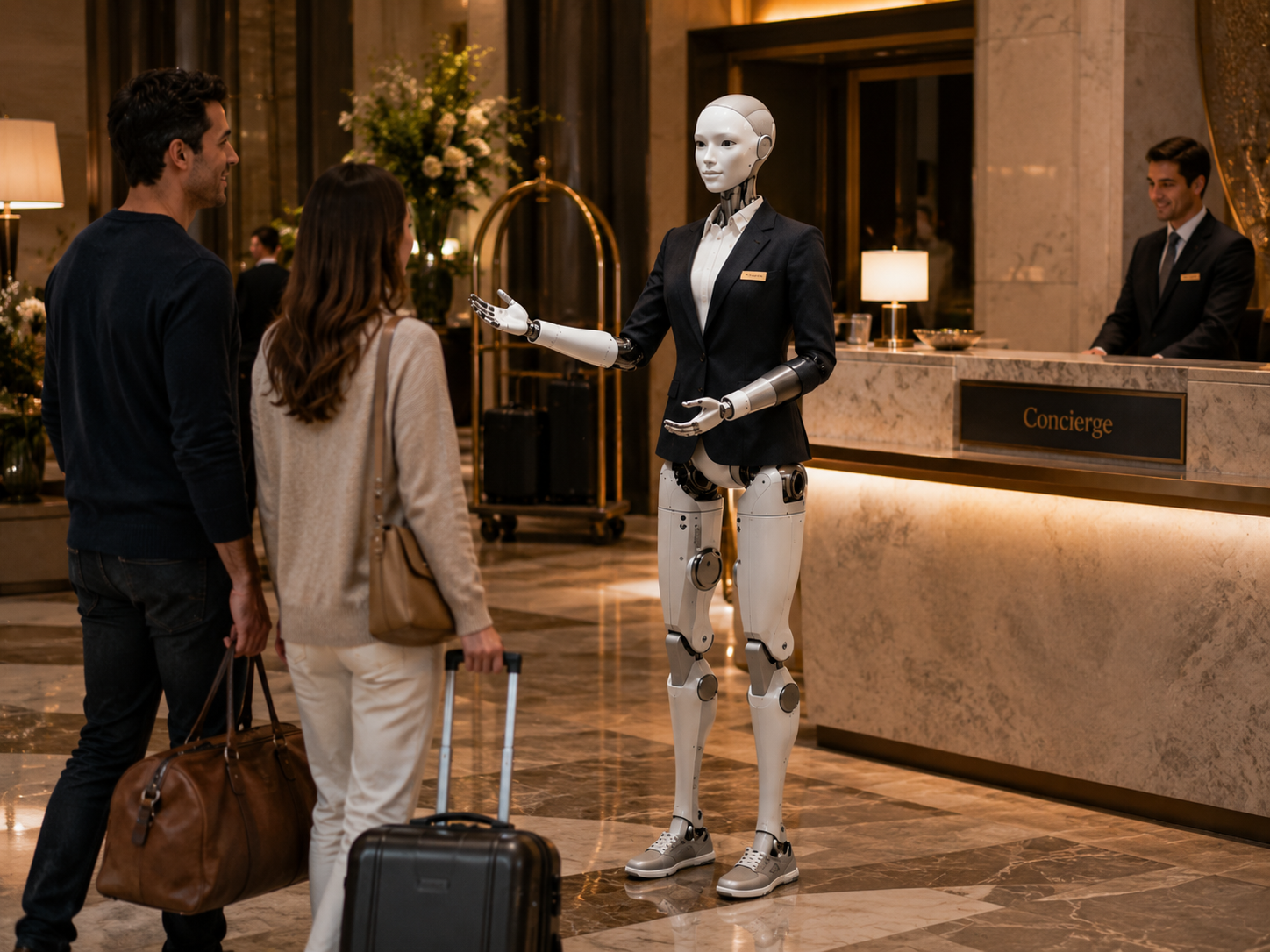
The Hospitality Concierge can become an immediately visible and approachable source of assistance — welcoming the guest, identifying amenities, answering common questions, and connecting them with the right human team member.
The objective is to help human teams remain focused on situations where empathy, judgment, discretion, and personalized service matter most.
Every deployment is configured around the property.
Capabilities, knowledge, personality, and guest journeys are customized to the hotel or resort's service standards, approved information, and operating model.
Welcome
Arrival greeting
Provide a warm, brand-appropriate welcome as guests enter the lobby or reception area — adapted to time of day, season, language, and property standards.
Property introduction
Orient new arrivals with an immediate overview: where to check in, where main amenities are, and who is available to help.
Preferred language
Begin in the guest's preferred language or invite them to choose. English and French can be included; additional languages may be explored based on property profile.
Inform
Amenity information
Explain restaurant hours, pool and spa access, fitness centre, parking, Wi-Fi, business centre, family services, and approved loyalty programme details.
Event and conference support
Configure event-specific knowledge: meeting room locations, registration procedures, schedules, speaker information, shuttle details, and group-specific content.
Local recommendations
Share property-approved recommendations for restaurants, attractions, transportation, and activities — maintained to reflect accurate availability and the hotel's preferred partnerships.
Guide
Property wayfinding
Help guests locate elevators, restaurants, meeting rooms, spas, pools, washrooms, parking access, business centres, and accessible entrances — by description, QR code, or approved map.
Staff routing
Recognize when a human team member is needed and direct guests clearly: "The front desk team is directly ahead and will be happy to assist."
Service request support
Help guests begin simple, non-urgent requests — additional towels, maintenance visibility, accessibility assistance — and route them to the appropriate team with context already established.
Enhance
Interactive moments
Provide approved experiential features: destination facts, property history, welcome messages for groups, children's questions, sustainability information, and curated content.
Group and conference welcomes
Be temporarily configured for a specific group, convention, or private function — a single humanoid platform supporting both normal hotel operations and selected event experiences.
Property storytelling
Share information about the building's design, neighbourhood, sustainability practices, or brand narrative in a way that enhances the guest's appreciation of the property.
A hotel is not an information kiosk.
The robot handles
Human staff remain essential for
From arrival to a helpful next step.
An interaction that is brief, useful, and appropriately escalated where human confirmation matters.
Arrival
Parking question
Parking information
Dining question
Hours confirmed
Dietary question
Careful escalation
The quality of the experience depends on the quality of the information.
The robot distinguishes three types of property information — and handles each with the appropriate level of caution.
Stable property information
Reliable for immediate answer. Rarely changes.
Frequently changing information
Requires a reliable update process or connection to an approved source.
Personal or account-specific information
Requires authentication, strong security, privacy controls, and integration planning. Not included in early pilots by default.
One archetype. Multiple property types.
Urban Hotels
Support international visitors, corporate travellers, conferences, local recommendations, and high-volume lobby questions.
Resorts
Explain activities, dining, recreation, spa services, family programs, transportation, and property navigation.
Conference Hotels
Provide meeting information, event wayfinding, registration support, sponsor acknowledgements, and group-specific content.
Luxury Properties
Create a distinctive arrival experience while maintaining a refined, restrained, and service-oriented tone.
Lifestyle Hotels
Become part of the property's identity through a more expressive personality, cultural recommendations, and programmed experiences.
Premium Residences
Welcome prospective tenants, explain amenities, support tours, and direct residents or visitors to appropriate services.
Casinos & Entertainment
Provide venue directions, entertainment schedules, promotional information, and guest-service routing within clearly defined boundaries.
Tourism Properties
Introduce the surrounding region, recommend activities, highlight local culture, and connect guests with approved tourism resources.
Six ways to use the Hospitality Concierge.
One property may use different configurations throughout the day. Each is purposefully positioned to serve a distinct operational need.
Lobby Welcome Concierge
Positioned near the main entrance to welcome guests and provide immediate direction.
Information Concierge
Positioned near reception to answer frequent questions and explain amenities.
Conference Concierge
Configured for a particular group, meeting, or convention.
Destination Concierge
Focused on surrounding attractions and local discovery.
Experience Concierge
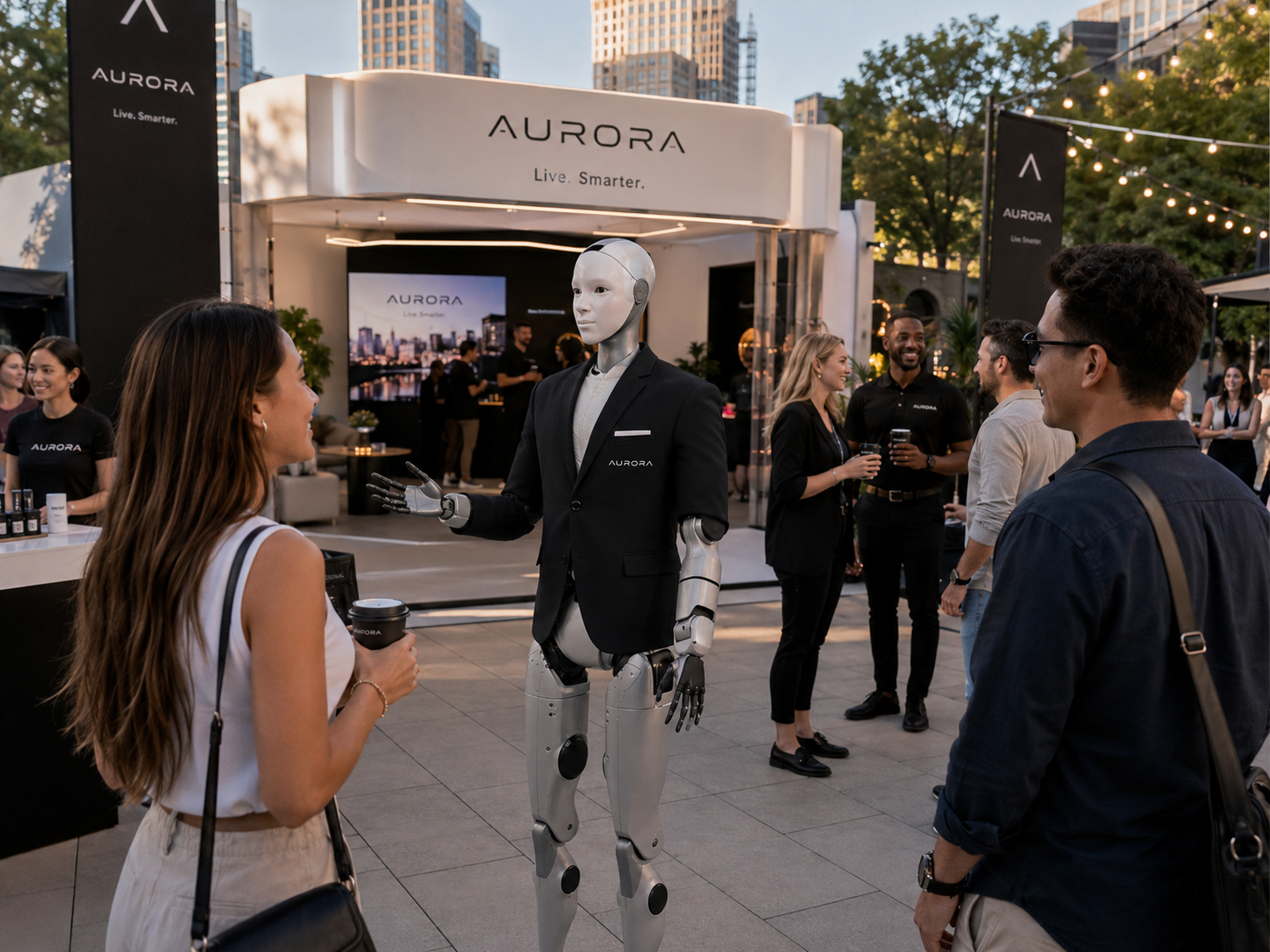
Designed as a memorable guest engagement and innovation feature.
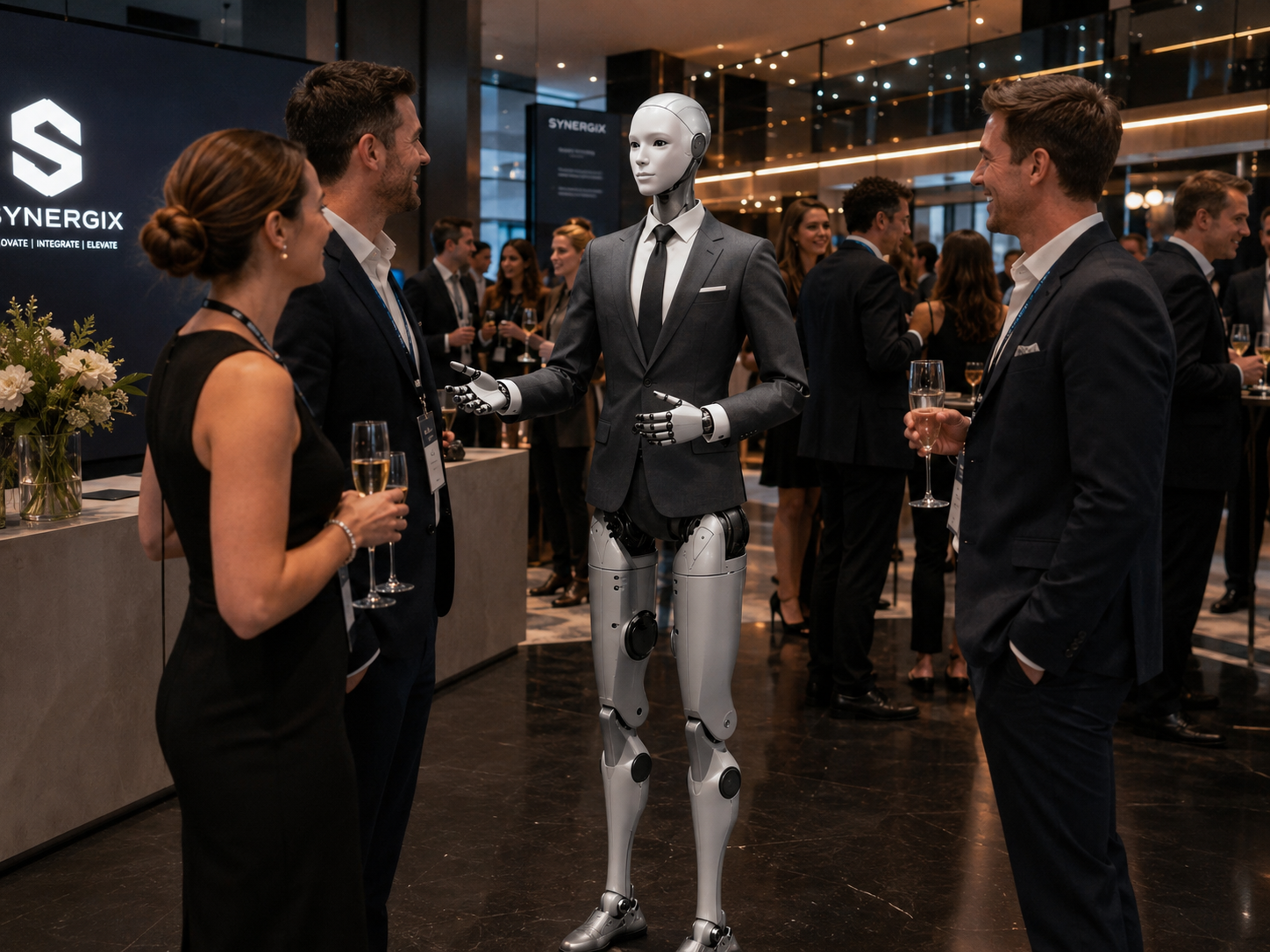
Evening Social Host
Used during receptions, lobby activations, tastings, or special programming.
Personalized without becoming intrusive.
Hospitality organizations are trusted with sensitive personal information. The Hospitality Concierge must be designed conservatively.
The robot may personalize the active interaction using information the guest voluntarily provides during the conversation. Early deployments should not include passive face recognition, hidden identity matching, or access to reservation records without authentication.
The robot should never respond publicly to questions such as: "Is Mr. Smith staying here?" — these require established property procedures and human review.
Core privacy principles
Start simple. Evolve thoughtfully.
The Hospitality Concierge can begin as a standalone informational experience and evolve toward selected integrations using a phased approach that reduces risk while demonstrating value early.
Approved property information
The robot answers questions using a controlled knowledge source and directs guests to existing staff or digital resources. No connection to private systems.
Non-sensitive service routing
The robot can submit selected requests or notify departments without accessing private reservation information.
Authenticated guest services
Selected account-specific interactions explored where identity, security, privacy, and system integration requirements have been fully addressed.
Understand how guests are using the robot.
Subject to the approved privacy framework, HumanoidX may provide anonymous deployment reporting that helps properties improve both the robot and the broader guest-information experience.
Example pilot insights
Guest interactions
Volume, timing, duration, and language preferences
Preferred languages
English, French, and other language requests
Common destinations
Most-requested wayfinding locations
Amenity questions
Restaurant, spa, fitness, and parking queries
Staff referrals
Frequency and category of human escalations
Peak periods
High-demand times: check-in, checkout, conferences
Hotels and resorts are active, unpredictable environments.
Guests may carry luggage, push strollers, use mobility devices, travel in groups, or be unfamiliar with the property. Deployment planning accounts for this from the start.
In many early pilots, the robot will remain within a designated lobby area rather than navigating throughout the hotel. A stationary or limited-mobility humanoid can still provide substantial value.
From property assessment to managed deployment.
HumanoidX remains the deployment and management partner rather than delivering the robot and leaving the property to solve the operational challenges alone.
Understand the property
Review the hotel or resort, guest profile, brand standards, lobby design, common questions, and operational challenges.
Define the concierge role
Determine where the robot should operate, which guests it should support, what it should know, and which requests to escalate.
Select a focused first use case
Target a clear objective: lobby welcome, conference wayfinding, amenity information, local recommendations, or group arrival support.
Prepare approved knowledge
The property supplies or validates all information the robot will use. No unrestricted public information as the default source.
Design the experience
Configure personality, greetings, languages, answers, guest journeys, escalation rules, and visual presentation.
Assess the environment
Evaluate traffic, flooring, power, network, accessibility, storage, transportation, and safety requirements.
Train and test
Test using realistic guest questions and simulated lobby conditions before the deployment opens.
Launch a managed pilot
Deploy for a defined period with human support, clear performance objectives, and daily operational checks.
Review and improve
Evaluate interactions, staff feedback, and guest response. Recommend expansion or optimization before the next phase.
Start with a focused, practical deployment.
The right first pilot is one that delivers clear value within a manageable scope — and builds the foundation for a longer-term hospitality partnership.