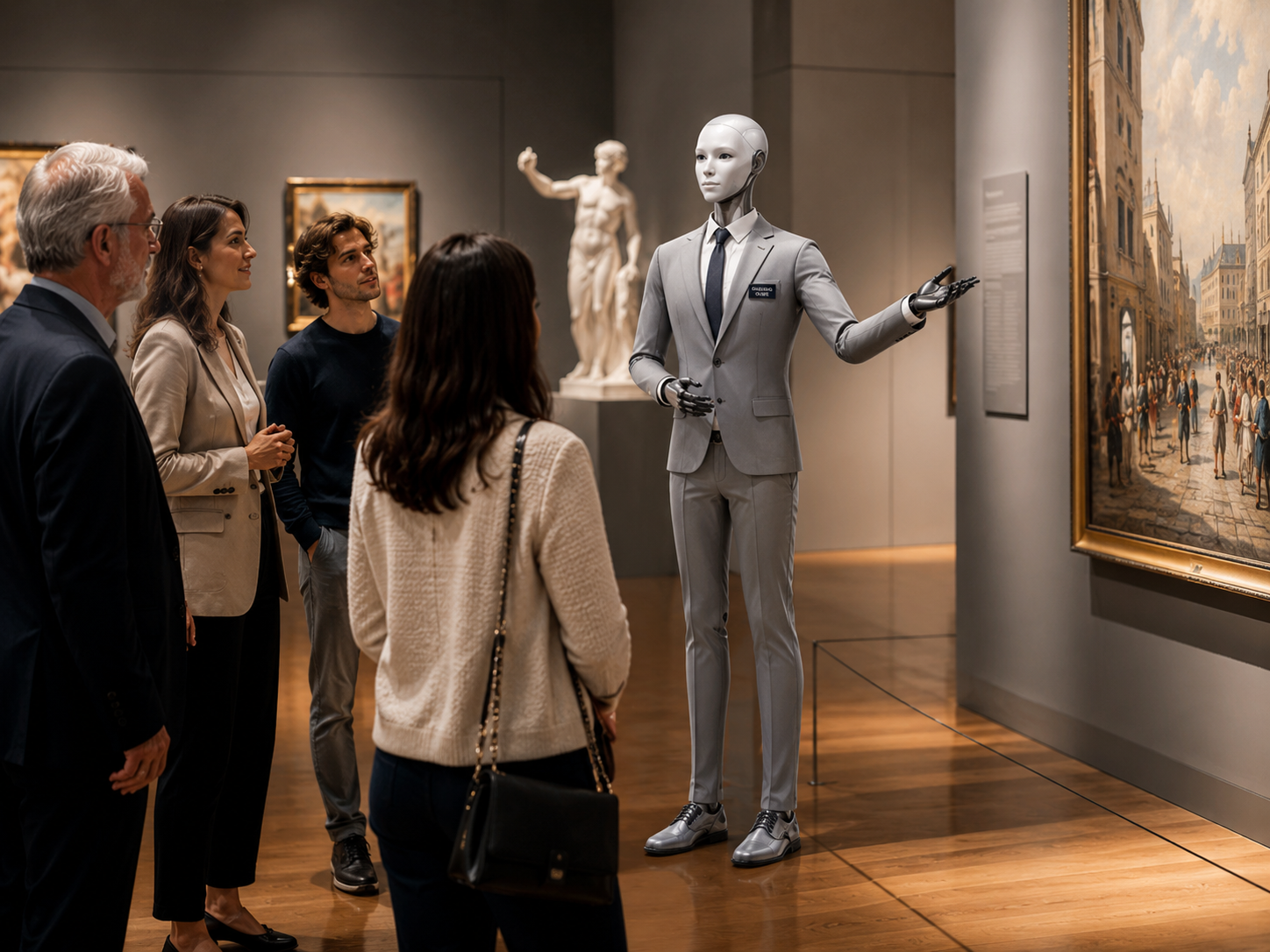
The object remains the hero.
The Museum Storyteller does not compete with the collection. It does not fill every moment with speech, motion, or entertainment. Its presence is carefully designed to encourage observation, add context, support questions, and direct attention toward exhibits — not toward itself.
Visitors may walk past an important object without understanding its significance. They may hesitate to read a long description. They may have questions but not know where to find a guide. Children may lose interest before discovering why an exhibit matters. The Museum Storyteller creates a visible and approachable point of interaction — directing more attention toward the museum's stories, objects, research, and people.
Six capabilities designed around the visitor's experience.
Every deployment is customized around the institution, collection, exhibition, visitor audience, educational objectives, approved content, accessibility needs, and selected humanoid robot platform.
Greet every visitor with the right opening.
The Museum Storyteller can greet guests at the entrance to a museum, gallery, exhibition, or selected interpretive zone. The welcome adapts to the institution, exhibition, visitor audience, preferred language, and level of formality.
"Welcome to the Montréal Centre for Discovery. Today, I can help you explore the exhibition on the future of cities. Would you like a quick introduction or a recommendation on where to begin?"
Share curator-approved information about selected exhibits.
The robot can explain what an object is, where it came from, when it was created, who made or used it, how it worked, why it was preserved, what researchers learned from it, and how it connects to the exhibition and to the present.
"The object in this display is a reconstruction based on surviving fragments and historical research. The original components are preserved under controlled conditions."
Invite visitors to look more closely before providing an answer.
The Museum Storyteller transforms visitors from passive listeners into participants. It can pause, ask what they observe, invite predictions, and prompt them to notice details before sharing the story behind an object.
"Before I tell you what this instrument was used for, take a look at its shape. What do you think the curved section might have helped someone measure?"
Direct attention back toward the physical exhibit.
The robot should not become a substitute for looking at the collection. Its role is to help visitors notice more. It can point to details, suggest perspectives, and connect what the visitor sees to what the museum knows.
"Notice the small marks along the edge. Those are evidence that the object was repaired and reused several times."
Lead visitors through a curated journey across selected exhibits.
The Museum Storyteller may offer themed pathways — a child-friendly highlights route, a 30-minute introduction, a science discovery trail, or a specialist deep-dive — using directions, approved scripts, and handoffs to human guides.
"One of the objects in the next gallery was once more valuable than gold. Can you find it?"
Introduce museum professionals when deeper expertise is required.
The robot introduces the topic. The museum's people provide the deeper expertise, interpretation, and human connection. Gallery interpreters, educators, curators, conservators, and visitor services staff remain central to the institution's mission.
"That question involves a more specialized interpretation. I can show you where to find the curator's complete explanation."
Visitors choose how deeply they want to engage.
The same exhibit can be experienced in seconds, as a one-minute story, as a family discovery, as a scholarly interpretation, or as an interactive challenge. Visitors can choose their depth — or the museum can configure a default based on the audience.
A quick explanation for visitors who want the essential idea.
"This object is one of the earliest tools used in the region to measure land accurately. It helped shape property boundaries and the development of early towns."
A short narrative with context, conflict, and significance.
Simple vocabulary, observation questions, and a memorable comparison.
More detailed historical, artistic, scientific, or technical context drawn from approved museum sources.
An interactive question or activity that encourages the visitor to investigate the exhibit.
A connection to a museum educator, curator talk, audio guide, publication, or digital resource.
From curiosity to a deeper understanding.
A family approaches a mechanical device. They are unsure what it does. The robot explains, asks, listens, and redirects attention toward the museum experience.
Object
A family stands near an old mechanical device and is unsure what it does.
Observation question
"Before I explain this machine, take a look at the large wheel and the series of numbered gears. What do you think it was designed to calculate?"
Visitor guess
"Maybe time?"
Story — building on the answer
"That is a very good guess. The machine was built to predict the movement of celestial objects and help people understand the calendar."
Related exhibit
"If you enjoyed this, the interactive astronomy table in the next gallery lets you create your own model of the solar system. Continue through the doorway on your left and follow the blue constellation symbols."
The robot has explained, asked, listened, and redirected attention toward the museum experience.
The same exhibit. Six different conversations.
The robot can offer different levels of explanation for children, families, general visitors, school groups, specialists, and tourists. Select an audience to see how the same object is explained differently.
Explaining what a fossil is:
"This is the bone of an animal that lived millions of years before your great-great-great-grandparents were born. Scientists found it buried deep underground. Can you find the bumpy part that shows where two bones used to join together?"
Four content layers — each handled with precision.
The museum retains authority over factual content, interpretation, terminology, cultural context, and educational messaging. HumanoidX configures the robot using institution-approved materials — and communicates uncertainty honestly when it exists.
Clearly established. The robot answers directly.
Attributed appropriately — the institution's position, not a universal truth.
Communicated honestly. The robot does not invent certainty to satisfy a question.
Not included in the public interaction system.
Some stories require more than information.
They require authority, context, and care.
Museums may present Indigenous history and knowledge, sacred objects, colonial history, war, genocide, displacement, contested ownership, repatriation, personal testimony, and living communities. The Museum Storyteller should not treat every subject as entertainment. The robot should not imitate accents, stereotypes, spiritual practices, or community identities for entertainment. Where an object or story belongs to a living culture, that community's voice and authority must remain central.
Art often invites multiple responses. The robot should not declare one correct.
The Museum Storyteller may help visitors observe colour, composition, materials, scale, technique, historical context, symbols, artistic movement, provenance, and conservation details. It then shares curator-approved context — without declaring a visitor's personal interpretation wrong.
Illustrative interpretation experience
"What did you notice first?"
Visitors often look at the largest shape, the brightest colour, or the most unexpected detail. The robot invites them to start there.
"How does scale change the experience?"
An artwork seen from a distance creates one feeling. Closer, it creates another. The robot encourages movement around the piece.
"Why might the material matter?"
The choice of stone, paint, textile, or found object communicates something. The robot connects material to meaning using curator-approved context.
In science centres, the robot explains the experiment — before, during, and after.
The robot should not independently supervise hazardous experiments or replace trained educators. It introduces, asks for predictions, describes the result, connects the activity to a scientific concept, and hands off to the next station.
Predict
Ask what the visitor expects to happen before the demonstration begins.
Try
Guide the visitor through the interaction safely. Remind them of the rules.
Observe
Draw attention to what just happened. What changed? What was unexpected?
Understand
Connect the result to the scientific principle. Provide a follow-up challenge.
Twelve institutional contexts. One archetype — adapted for each.
History museums
Artifacts, timelines, social change, historical figures, everyday life, and contested interpretations.
Science centres
Experiments, scientific principles, demonstrations, and hands-on learning.
Technology museums
Inventions, engineering, robotics, transportation, computing, and industrial history.
Art museums and galleries
Visual observation, artistic context, technique, themes, and visitor reflection — without false certainty.
Natural history museums
Fossils, geology, ecosystems, evolution, biodiversity, and scientific research.
Children's museums
Playful, age-appropriate interactions within carefully supervised environments.
Cultural institutions
Traditions, communities, language, and material culture — using content approved by relevant cultural authorities.
Historical sites
Heritage buildings, monuments, archaeological areas, and commemorative locations.
Visitor attractions
Thematic storytelling, guest orientation, schedules, and interactive experiences.
Travelling exhibitions
A repeatable interpretive experience that moves between approved venues.
Corporate museums
Company history, innovation, products, research, and industry impact.
University museums
Academic collections, faculty research, student projects, and public programming.
The robot opens the story. Museum professionals provide the depth.
The humanoid can open the story
Museum professionals provide the depth
Eight roles across the museum experience.
The same archetype can be reconfigured for different exhibitions, audiences, and institutional contexts throughout the programming year.
Exhibition Welcome Storyteller
Introduces a temporary or permanent exhibition and recommends where to begin.
Featured Object Interpreter
Positioned near one major object or display for deeper storytelling.
Science Demonstration Guide
Introduces interactive scientific exhibits and explains results.
Family Storyteller
Provides playful, age-appropriate explanations and discovery challenges.
Museum Highlights Guide
Introduces a curated selection of must-see exhibits.
School Group Assistant
Supports a museum educator during structured learning visits.
Cultural Event Host
Supports lectures, openings, receptions, public programs, and donor events.
Corporate Heritage Guide
Explains the history and innovation of a company or industry.
Begin with curated content. Expand deliberately.
A robot that tells five exceptional stories reliably is stronger than a robot that attempts to explain the entire collection poorly. The first pilot should remain focused — the integration roadmap enables growth at the institution's pace.
Curated exhibit knowledge
The robot explains selected exhibits using institution-approved content.
Current events and visitor information
The robot receives updated schedules, closures, program information, and gallery changes.
Interactive exhibit connections
The robot may trigger a display, video, light, sound, or approved demonstration.
Personalized visitor journeys
The robot may help visitors build a route or save selected resources through a consent-based interface.
Most museum storytelling does not require personal information.
The archetype should therefore begin with minimal data collection. The robot can ask "Would you like the family explanation or the detailed explanation?" — without recording that preference permanently.
Core privacy principles
The Museum Storyteller creates additional ways for visitors to access information.
The robot should not create excessive sound or motion in sensory-sensitive environments. Museums may choose specific hours or modes for quieter interactions.
Museums contain fragile, valuable, and sometimes irreplaceable objects.
The robot should never carry, touch, lean on, point too closely toward, or physically manipulate museum objects unless the object is a specially designed educational replica and the interaction has been tested.
Understand how visitors engage with your content.
Frequent questions about one object may suggest an opportunity for stronger signage, digital interpretation, or a future curator talk — not just a more capable robot.
Example visitor insights
Most requested exhibits
Which objects attract the most questions, stories, and repeat engagement.
Story selections
Whether visitors prefer quick highlights, family explanations, or deeper interpretations.
Common questions
Recurring visitor questions that may signal content gaps in signage or digital resources.
Preferred languages
English, French, and bilingual interaction patterns by exhibition and time of day.
School-group interactions
Quiz participation, group welcome engagement, and curriculum activity completion.
Human-guide referrals
How often and why the robot directed visitors to a museum professional.
Ten steps from institutional discovery to pilot expansion.
HumanoidX works with the museum's curators, educators, interpreters, and operational teams to ensure that the humanoid experience supports the institution's mission and standards.
Identify the visitor objective
Define what the museum wants visitors to understand, feel, explore, or do.
Select a focused exhibition or zone
Start with one featured object, one temporary exhibition, a visitor welcome area, a family gallery, a science demonstration, or a school-group program.
Define the robot's role
Determine whether it will introduce, explain, question, guide, entertain, or connect visitors with staff.
Prepare approved content
The museum supplies or validates factual information, curatorial interpretation, stories, terminology, images, and visitor resources.
Design audience modes
Create appropriate versions for families, adults, children, school groups, or other intended visitors.
Assess the physical environment
Review collection safety, flooring, lighting, sound, traffic, power, network access, accessibility, and robot placement.
Configure and test
Develop the personality, languages, stories, questions, fallback responses, gestures, and staff escalation rules.
Test with representative visitors
Test with children, families, adults, bilingual visitors, school groups, visitors with accessibility needs, complex questions, sensitive subjects, and quiet-gallery conditions.
Launch a managed pilot
The robot is deployed for a defined period with staff support, clear objectives, and performance monitoring.
Review and expand
Evaluate visitor response, content quality, staff feedback, technical reliability, and opportunities for additional exhibits or roles.
Seven focused, measurable starting points.
Each pilot targets one clearly defined exhibition context so performance can be evaluated honestly and used to plan the next phase.